
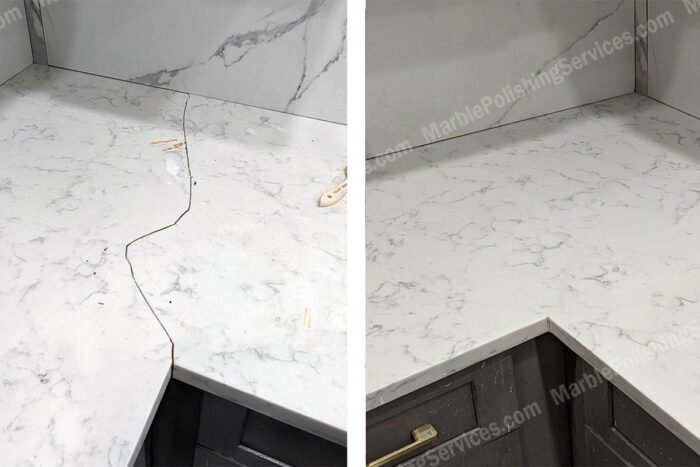
Quartz Countertop Crack: A Homeowner’s Guide to What Happened and What To Do Next
Quartz countertops have become one of the most popular choices for modern kitchens. They offer a beautiful, contemporary appearance and are known for being durable, low-maintenance, and highly resistant to everyday stains and scratches.
However, there is a common misconception that quartz countertops are indestructible.
You may hear that quartz cannot scratch, cannot stain, and is completely heat-resistant. While quartz is a very durable material, these statements are not entirely accurate. Like any countertop material, quartz has limitations and can be damaged under certain conditions.
Quartz countertops are engineered surfaces made from a combination of minerals—primarily quartz—along with resins, pigments, and other materials. The exact composition varies depending on the manufacturer and the specific product. Many premium quartz products contain a very high percentage of quartz or other mineral content, while the remaining portion consists primarily of resins and additional components used to create the desired strength, color, and appearance.
This is one reason why not all quartz countertops are the same.
There are many manufacturers and products available today, and quality can vary significantly depending on the materials, manufacturing process, and quality control. Well-established brands such as Caesarstone, Silestone, Cambria, and Viatera have extensive manufacturing standards and quality-control processes.

Quartz Countertop Crack Repair in New Jersey, New York & Philadelphia
Table of Contents
- Why Quartz Countertops Can Crack
- What Should You Do If Your Quartz Countertop Cracks?
- What To Do the Moment You Notice a Crack
- Should You Repair a Cracked Quartz Countertop Yourself?
- How Is a Crack in a Quartz Countertop Repaired?
- Will the Repair Be Invisible?
- When a Crack Needs More Than Just Filling
- What Does Quartz Crack Repair Cost?
- How to Prevent Future Cracks
- Frequently Asked Questions
1. Why Quartz Countertops Can Crack

In our experience working with quartz countertops, cracks can occur for several different reasons.
One important factor is the quality of the quartz itself. When purchasing a quartz countertop from an unknown manufacturer or supplier, it can sometimes be difficult to determine the actual quality and composition of the material. Not all quartz products are manufactured to the same standards, and lower-quality materials may be more susceptible to damage under certain conditions.
Unfortunately, the market contains many quartz products that are imported and sold at significantly lower prices. For the average homeowner, it can be very difficult to know where the stone was manufactured, what materials were used, or what quality-control standards were followed. This is why choosing a reputable manufacturer and a reliable supplier is extremely important when purchasing a quartz countertop.
One common cause of cracking is excessive heat. Quartz is not designed to withstand direct contact with extremely hot pots and pans. Placing a very hot pan directly on the countertop can create thermal stress and potentially damage the resin within the material.
Cracks can also develop because of improper installation, insufficient support, excessive pressure, movement in the cabinets, or improperly cut openings, particularly around sinks and cooktops.
This is why a crack does not necessarily mean that the quartz itself is defective. In many situations, the cause may be a combination of the material’s quality, installation, structural support, or the conditions surrounding the countertop.
When it comes to quartz, the quality of the material matters just as much as the installation.
Why Do Quartz Countertops Crack? 9 Common Causes
- Improper installation — a slab that was not installed on a flat, properly prepared, and fully supported base.
- Insufficient support underneath — especially over open cabinet spans, dishwasher openings, or other areas where the slab does not have adequate support.
- Settling or shifting of the cabinets or the house itself — movement over time can place stress on the countertop and eventually lead to cracking.
- Stress at inside corners — particularly at the inner corners of L-shaped or U-shaped countertops, where stress can naturally concentrate.
- Weak points around cutouts — areas around sinks, cooktops, and outlets have less material supporting the slab and can therefore be more vulnerable to cracking.
- Uneven cabinets or improper shimming — uneven support can create constant pressure on specific areas of the quartz.
- Sudden impact or excessive point pressure — such as someone sitting or standing on an unsupported overhang or placing excessive weight on a vulnerable area.
- Thermal shock — placing a very hot pan, pot, or other heat source directly on the quartz surface can create sudden temperature changes and stress the material, potentially causing cracks or other damage.
- Material quality and composition — not all quartz countertops are manufactured to the same standards. The quality, composition, manufacturing process, and resin-to-mineral ratio can vary between manufacturers and products. Lower-quality or poorly manufactured quartz may be more susceptible to cracking, particularly when combined with heat, improper installation, or insufficient support.
2. What Should You Do If Your Quartz Countertop Cracks
Why Quartz Countertops Can Crack
If you notice a crack, chip, or other damage, do not immediately assume that the entire countertop needs to be replaced.
The first step is to determine what caused the damage and how severe it is.
A professional should examine whether the countertop is stable, whether there is movement around the damaged area, whether the countertop has adequate support underneath, and how deep the crack actually is.
One of the biggest mistakes homeowners make is immediately purchasing repair products online and attempting to fix the damage themselves. Although many repair kits and adhesives are available online, having the right product does not mean knowing how to use it properly. Without the proper experience and technique, a DIY repair can make the damage more noticeable or create additional problems that are much more difficult to correct.
Quartz countertop repair is a cosmetic and highly specialized process. Achieving a professional-looking result requires experience, knowledge of different quartz materials, proper surface preparation, color matching, and, most importantly, knowing which adhesives and repair materials are appropriate for the specific type of damage.
That’s why we always recommend consulting a professional before attempting a repair yourself. Look for a technician who has actual experience repairing quartz countertops, ask to see examples of previous work, and watch videos of repairs they have completed. Seeing the technician’s actual work can give you a much better idea of their skill and the quality of the results you can expect.
Depending on the condition of the countertop, it may be possible to perform a professional localized repair rather than replacing the entire surface.
At Mega Marble, we don’t simply look at the visible crack. We also try to identify the possible cause of the damage so we can recommend the most appropriate repair method for the specific countertop.
Before you buy a DIY repair kit, get a professional opinion. The right repair technique can make the difference between restoring your countertop and making the damage worse.
3. What To Do the Moment You Notice a Quartz Countertop Cracks

What To Do the Moment You Notice a Quartz Countertop Cracks
This is the part most articles skip, and it matters. Your actions in the first hours and days after spotting a crack can affect how well it can be repaired.
- Stop putting weight or pressure near it. Don’t lean, sit, or set heavy items on that section of the countertop.
- Keep the area dry and clean. Wipe up spills quickly — liquid, oil, and food particles can seep into a crack and make it harder to bond later, and can also cause staining around the damaged area.
- Don’t use harsh cleaners or abrasive scrubbers on it. Stick to a mild, non-abrasive cleaner so you don’t widen the crack or damage the surrounding finish.
- Avoid heat near the crack. Don’t set hot pots, pans, or appliances directly on or near the area.
- Take clear photos in good lighting, including a wide shot showing the crack’s location and a close-up with something for scale. This helps a technician give you a more accurate initial estimate.
- Don’t apply super glue, clear caulk, or hardware-store epoxy yourself. It’s tempting, but generic adhesives often don’t match quartz color or hardness, can trap moisture inside the crack, and may make a professional repair more difficult later.
- Note what might have caused it, if you know. This helps determine whether the crack is a one-time event or a sign of an ongoing support issue.
- Check if the crack is still moving. Mark each end lightly with a pencil dot and check again in a few days.
- Schedule an inspection reasonably soon. The longer a crack is exposed to daily use, moisture, and temperature changes, the more likely it is to grow or collect grime.
4. Should You Repair a Cracked Quartz Countertop Yourself?

Should You Repair a Cracked Quartz Countertop Yourself?
DIY quartz countertop crack-repair kits are widely available online, and they may look like a simple and inexpensive solution. However, repairing quartz professionally requires much more than simply filling a crack with glue.
One of the biggest mistakes homeowners make is trying to repair the damage themselves. Without the proper experience, it is very easy to make the damage worse—and once a failed DIY repair has been attempted, the professional repair can become more complicated and more expensive.
Experience and skill in quartz countertop repair take many years to develop. This type of work is truly an art. Achieving a clean, professional-looking repair requires knowledge of different quartz materials, proper surface preparation, precise color matching, and experience working with the correct professional adhesives and repair materials.
If your countertop is important to you and you want the repair to look as good as possible, it is always b מetter to call a professional with years of hands-on experience. You may think you are saving money by attempting the repair yourself, but if something goes wrong, you could end up paying significantly more to correct the damage.
Here are some of the main problems with DIY quartz repairs:
- Color matching is difficult without experience, especially when the quartz contains multiple colors, flecks, patterns, or veining.
- The wrong adhesive can cause additional problems. Many products sold online are generic adhesives and are not designed specifically for professional quartz countertop repairs.
- Removing an improper repair can be difficult. If the wrong glue or filler has already been applied, a professional may first have to remove the existing material before a proper repair can be performed.
- You may create more visible damage. Excessive adhesive, incorrect application, poor color matching, or improper surface preparation can make the repair more noticeable than the original crack.
- DIY repairs do not solve the underlying problem. If the crack was caused by inadequate support, cabinet movement, improper installation, or another structural issue, simply filling the crack will not prevent it from coming back.
Most importantly, trying to save money on a DIY repair can end up costing you much more in the long run.
When it comes to an important countertop, don’t take a chance. Choose experience, skill, and professional workmanship from the beginning.
5. How Is a Crack in a Quartz Countertop Repaired?

How Is a Crack in a Quartz Countertop Repair?
When a quartz countertop develops a crack, the crack is usually very narrow. Because of its small size, it can be very difficult for the repair material to penetrate the crack completely. Even when the adhesive is able to enter the crack, it may not reach all the way to its full depth.
When a customer wants to repair a crack, the goal is usually not only to improve the appearance but also to prevent dirt from becoming trapped inside the crack and making it more noticeable.
In some cases, with the customer’s approval, the technician may carefully open the crack slightly to allow the repair material to penetrate more effectively. The crack is then filled with adhesive or a two-part repair material, using a color selected to match the quartz countertop as closely as possible.
It is important to understand that a quartz crack repair can never be matched 100% to the original color and pattern of the countertop. In most cases, the repaired area may still be somewhat visible. How noticeable the repair is depends on the type of quartz, the location of the crack, the pattern and color of the surface, and the technician’s ability to match the repair material accurately.
In addition, a strong, high-quality repair material may, in some cases, help stabilize the cracked area and reduce the possibility of the crack opening further. However, this depends greatly on the reason the crack occurred, the construction and support of the countertop, and the repair materials being used.
What About Polishing After the Repair?
After repairing a crack, some customers choose to have the repaired area polished. It is possible to polish only the specific area where the repair was performed, but it is important to understand that spot polishing can sometimes create a slight difference in the level of shine between the repaired area and the rest of the countertop.
Some customers are comfortable with this and prefer to have only the repaired area polished. Other customers, especially those who want the countertop to have a completely consistent appearance and shine, may prefer to have the entire countertop polished.
Polishing the entire countertop is a more extensive process and therefore costs more than polishing only the repaired area. Of course, the customer can also choose to have the crack repaired without any polishing if they prefer.
| Option | What It Involves | Best For | Cost |
|---|---|---|---|
| Polish only the repaired area | Just the crack area is smoothed and finished | Budget-conscious homeowners comfortable with a slight sheen difference | Lowest cost |
| Polish/refinish the entire countertop | The whole surface is professionally treated for a uniform finish | Homeowners who want a seamless, consistent appearance | Highest cost |
| Repair only, no polishing | Crack is filled and stabilized, no additional finishing performed | Homeowners prioritizing function and stability over final shine | Lowest add-on cost |
Understanding Why the Crack Occurred Is Important
When the technician arrives, they do not look only at the crack itself. They also inspect the condition of the countertop and ask the customer questions about how and when the crack developed.
For example, the technician may ask whether a very hot pot or pan was placed on the countertop, whether there was an impact or excessive pressure on a specific area, or whether the crack appeared without any obvious reason.
During the inspection, the technician may also identify, in some cases, a potential problem related to the original installation or the support underneath the quartz countertop.
Therefore, it is important to understand the cause of the crack before performing the repair. This helps determine the most appropriate repair method and can reduce the risk of the crack returning.
6. Will the Repair Be Invisible?

Will the Repair Be Invisible
Here’s the honest answer: usually close, but not always perfect.
Because quartz slabs often contain multiple colors and particle patterns, it can be genuinely difficult to match a repair to the surrounding surface 100%. Depending on the color and design of your countertop, the repaired line may remain slightly visible, particularly up close or under certain lighting.
That said, a good repair does more than just look better:
- It seals the crack so dirt, liquid, and bacteria can’t collect inside it
- It stabilizes the area and helps prevent the crack from spreading
- It restores much of the surface’s structural integrity
- It significantly improves the appearance, even if it isn’t 100% invisible
7. When a Crack Needs More Than Just Filling
Sometimes the crack itself is a symptom of a bigger issue. If cabinets have shifted or the countertop was never fully supported, filling the crack alone may not stop it from returning. A technician may recommend:
- Adding support underneath the cracked section
- Shimming or leveling uneven cabinets
- Reinforcing the underside of the slab near the crack
8. What Does Quartz Crack Repair Cost?
As a general guide, basic quartz crack repair typically starts around $550, though the final price depends on:
- The size and depth of the crack
- Its location (a corner or cutout may take more work than a straight section)
- Whether the crack needs to be opened and reinforced
- Whether any additional structural support is needed
This base estimate usually does not include grinding or polishing the entire countertop. Diamond-abrasive grinding of a full surface is a separate, more involved process, priced separately.
9. How to Prevent Future Cracks
- Always use a trivet or hot pad — never place pots, pans, or hot appliances directly on the surface
- Don’t stand, sit, or kneel on any part of the countertop, especially overhangs or areas near cutouts
- Support overhangs properly — beyond about 6–10 inches, use corbels or brackets underneath
- Watch weight near sink and cooktop cutouts, which are naturally weaker points
- Have cabinets checked and leveled if you notice shifting or unevenness developing
- Avoid dragging heavy appliances or cookware across the surface
10. Frequently Asked Questions
Can a quartz crack get worse if I wait to repair it?
It can. Daily use, temperature changes, and moisture exposure can cause a crack to lengthen or collect grime that’s harder to clean out.
Is quartz crack repair permanent?
No repair can be guaranteed 100% permanent in every case, especially if the underlying cause isn’t also addressed. A properly performed repair significantly reduces the chance of the crack reopening.
Will my homeowner’s insurance or manufacturer’s warranty cover this?
That depends on the cause of the crack and your specific warranty terms. Manufacturer warranties often exclude damage from impact, heat, or improper installation.
How long does the repair take?
Simple crack repairs are often completed in a single visit, though curing time and any additional polishing can extend the total time.
Can I still use my countertop normally after the repair?
Most technicians will advise avoiding heavy use, heat, and moisture on the repaired area for a set curing period before returning to normal use.
The Bottom Line
A crack in a quartz countertop is stressful to notice, but it’s rarely a reason to replace the whole slab. In the moment, the best things you can do are simple: stop putting stress on the area, keep it clean and dry, avoid DIY glue, take good photos, and get it evaluated. From there, a professional can walk you through realistic expectations — including how invisible the repair can be, whether extra support is needed, and which finishing option fits your budget.